Anker SOLIX F3800 Plus deep dive
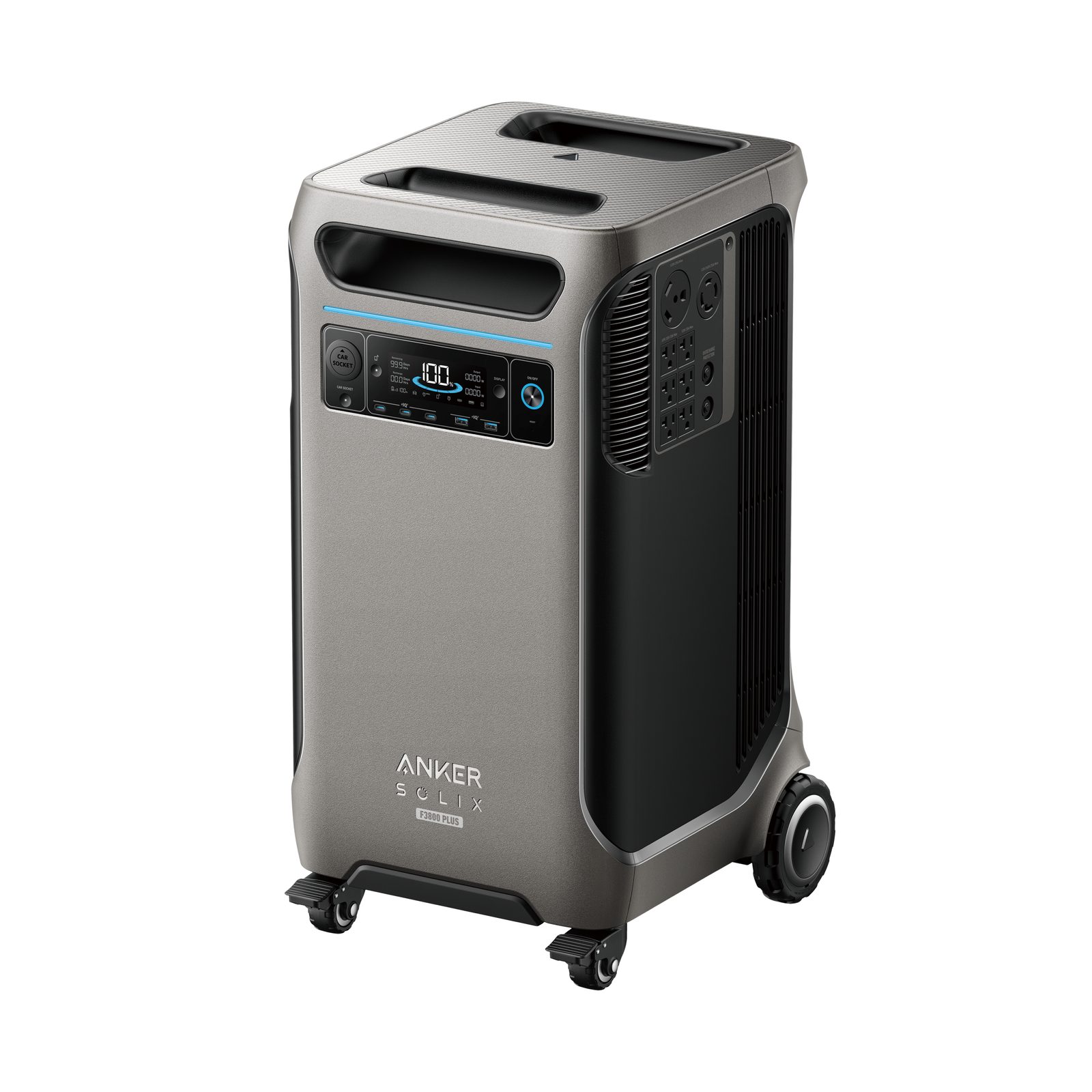
The F3800 Plus is the output champion of the big three: 3,840Wh rated (about 3,264Wh usable) behind 6,000W of native 120/240V split phase output, which is what a home panel actually speaks. If your backup plan includes a well pump, a furnace, and kitchen circuits starting in overlapping windows, this is the box built for it. In our checked system configuration it totaled about $4,618.03 with four panels and Indiana tax, slightly under the EcoFlow system.
Why native split phase matters
Many stations reach 240V only by pairing two units with a combining accessory. The F3800 Plus does it from one box. One box means one battery gauge, one charger, one thing to maintain, and a transfer switch installation an electrician will recognize immediately. For the growing number of homes whose critical list includes a 240V well pump, this single feature decides the purchase, and it should: a station that cannot start your pump is a very expensive phone charger. The whole-home explainer covers split phase in plain terms if the concept is new.
The adapter cable gotcha, priced in
Our research found one genuine annoyance: the F3800 Plus solar input expects a connector arrangement that standard panel leads do not plug straight into, so the right adapter cable belongs in the cart from day one. It is a small cost and it is included in the system total quoted on this page. It only becomes a problem when it is discovered on delivery day with four panels leaning against the garage. Buy the cable with the station, and check our compatibility explainer before any panel order, because input voltage limits apply to this station exactly as to every other.
Against the other two, honestly
Versus the DELTA Pro 3, the Anker gives up about 220 usable watt hours and some refill headroom in exchange for the stronger output stage. Versus the Apex 300, it is nearly twice the money as a system and roughly twice the machine. None of that is a flaw. It is a specialist: the pick when output, not capacity, is the binding constraint. The full three way math is in the head to head comparison.
The numbers that decide it
| Figure | F3800 Plus | Why it matters |
|---|---|---|
| Rated capacity | 3,840 Wh | Slightly smaller tank than the EcoFlow |
| Usable capacity at 85% | 3,264 Wh | The number every runtime on this site is planned from |
| Continuous output | 6,000 W, native 120/240V split phase | The strongest output stage of the three, from one box |
| Solar input | Accepts a full four panel 400W array (adapter cable required, priced in) | Refill speed matches the battery size |
| Checked system total | $4,618.03 | Station, four panels, cables, adapter, 7 percent Indiana tax |
| Cost per usable Wh | $1.41 | Highest of the three by two cents; the full table is here |
Starting hard loads, in numbers
Output is a worst second problem, not an average problem. Loads start when they start, and two motors can demand their surges in the same second. Here is the worst realistic second on a whole-home list, using this site's planning figures (a 1/2 HP sump pump surging to about 3,000 watts, a fridge surging to about 800, a freezer running at 120, lights at 36):
| That second | Watts demanded |
|---|---|
| 1/2 HP sump pump starting | about 3,000 W |
| Fridge compressor starting at the same moment | about 800 W |
| Freezer, lights, router already running | about 170 W |
| Total worst second | about 3,970 W |
Against the F3800 Plus's 6,000W continuous output, that second passes with a third of the output stage still in reserve, which is exactly the headroom a furnace blower or a second pump needs. Against a 3,000W class station, the same second is a trip and a dark basement. This is the entire case for the Anker, stated in one table: capacity decides how long, output decides whether at all. The surge math behind the pump figures is in our sump pump guide.
Who should skip this
Skip it if your load list is all 120V and light. You would be paying for an output stage you never use, and the money is better spent on the EcoFlow's extra capacity or on panels. Skip it also if it will be moved often; like its rivals, it is a park it and leave it device.
Plain links to the manufacturer. We may earn a commission on purchases in the future; today these links are not tracked.
Your next step: see the three big stations head to head.
Read the head to head