BLUETTI Apex 300 deep dive
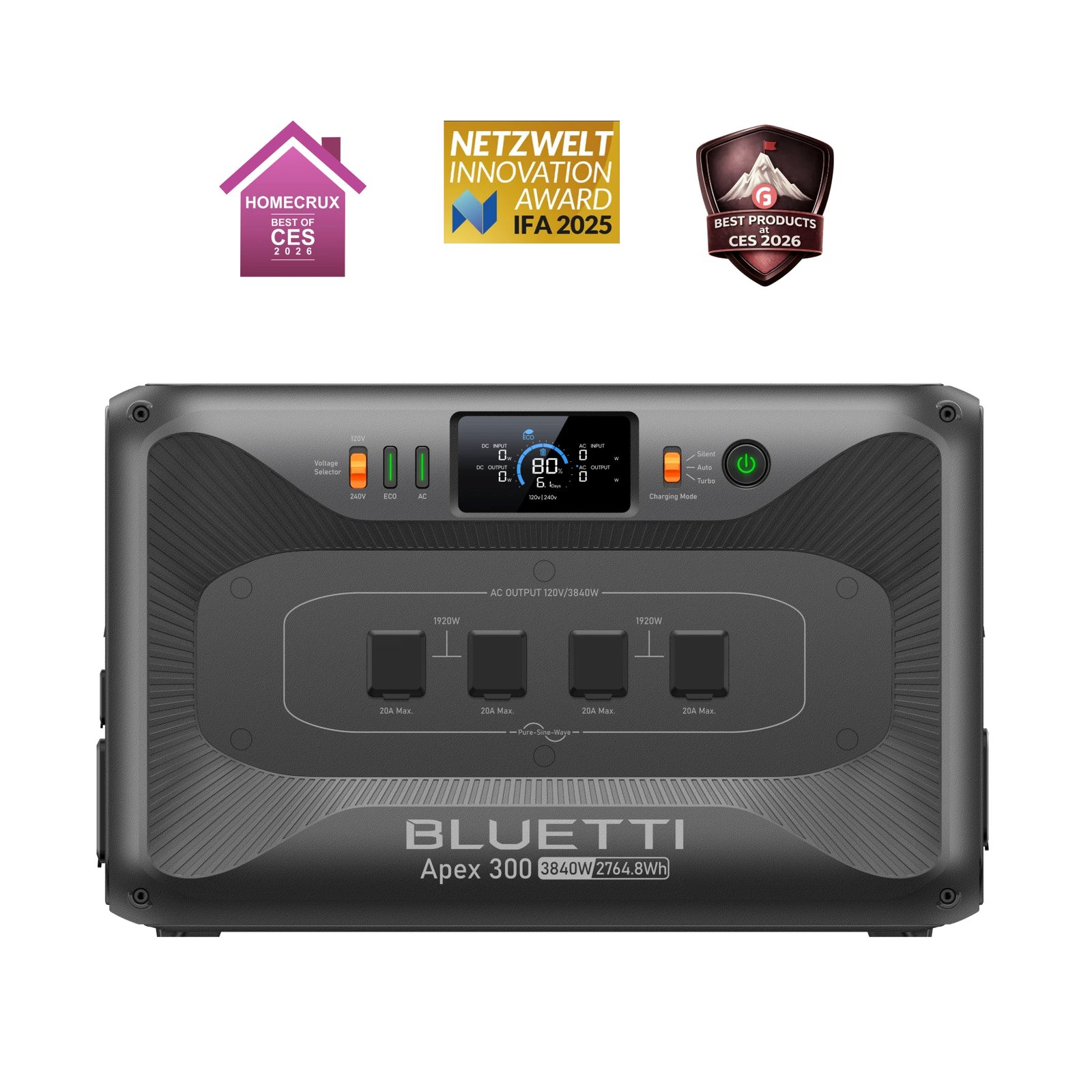
The Apex 300 is the cheapest honest way into real home backup: 2,764.8Wh rated, about 2,350Wh usable, and a complete system with panels and tax at about $2,765.86 in our checked configuration, roughly $2,000 less than its two big rivals. The catch is structural, not hidden: its solar input caps at 800W, so it refills slowly, and for multi day outages it really wants an expansion battery. Buy it with open eyes and it is the value pick of the class.
The value case, in numbers
At $1.18 per usable watt hour as a complete system, the Apex 300 undercuts the EcoFlow system ($1.39) and the Anker system ($1.41) in our checked configurations, and the outright gap buys a lot of groceries, or the expansion battery that fixes its biggest weakness. For the most common real outage, a day or less with a fridge, a freezer, lights, and phones, 2,350 usable watt hours is genuinely sufficient: that load list averages near 150 watts, which is over 15 hours, and with two panels replacing part of the draw it stretches further. Our cost table shows the math and keeps it updated.
The 800W ceiling, and what it really costs you
Solar input is refill speed. At an 800W cap with two 400W panels, a perfect Midwest day returns roughly 2,700Wh before losses, call it about 2,300Wh of real harvest. That is approximately what the battery holds, so in good sun the Apex roughly breaks even against a careful load list, and in winter sun or cloud it falls behind a little more each day. The four panel rivals harvest nearly twice as fast. This is not a defect at the price. It is the definition of the product: a one to two day machine, priced like one. Plan outages accordingly and it will never surprise you.
The expansion battery is part of the product
BLUETTI sells expansion batteries that stack onto the Apex 300, and for households with two and three day outage histories, the honest recommendation is to price the station plus one expansion from the start rather than discovering the need during the second night. Even expanded, the system tends to land near or under the rivals' base system prices, which keeps the value argument intact. What expansion does not fix is the solar ceiling: a bigger tank behind the same narrow doorway still refills at 800W.
The numbers that decide it
| Figure | Apex 300 | Why it matters |
|---|---|---|
| Rated capacity | 2,764.8 Wh | The smallest tank of the three, priced accordingly |
| Usable capacity at 85% | 2,350 Wh | The number every runtime on this site is planned from |
| Solar input cap | 800 W | Two 400W panels maximum; the structural limit of the product |
| Output class | 120V class in base form | Extension cord duty and a shorter critical list |
| Checked system total | $2,765.86 | Station, two panels, cables, 7 percent Indiana tax |
| Cost per usable Wh | $1.18 | Cheapest of the three; the full table is here |
A two day outage, budgeted honestly
Take the careful load list this site uses everywhere (fridge, freezer, lights, and phones averaging about 150 watts together, or about 3,600 watt hours a day) and the harvest figure from the section above (about 2,300 watt hours returned on a good day through the 800W cap):
| Point in the outage | Battery state |
|---|---|
| Outage starts, battery full | 2,350 Wh usable |
| End of day one (3,600 used, about 2,300 harvested) | about 1,050 Wh left |
| Day two at the same pace | Empty by mid afternoon |
| Day two with loads trimmed to about 100 W average (2,400 Wh a day) | Roughly holds even while the sun shines |
That table is the whole product in miniature. The Apex 300 plus decent sun covers a one day outage outright, a two day outage with discipline, and it does not pretend to cover a three day outage at full loads. Buyers who trim loads on day two (freezer on a timer, lights off in empty rooms, phones charged from the car) routinely stretch it further. Buyers who run it like the grid is up learn the ceiling at the worst moment. Neither outcome is the battery's fault; both are visible in this arithmetic before purchase.
Who should skip this
Skip it if your outages regularly run past two days, if your critical list includes heavy 240V loads the base unit is not built to serve, or if fast solar recovery is the whole point of your purchase. In those houses the EcoFlow or the Anker earns its premium, and our head to head shows exactly where.
Plain links to the manufacturer. We may earn a commission on purchases in the future; today these links are not tracked.
Your next step: see the three big stations head to head.
Read the head to head