EcoFlow DELTA Pro 3 deep dive
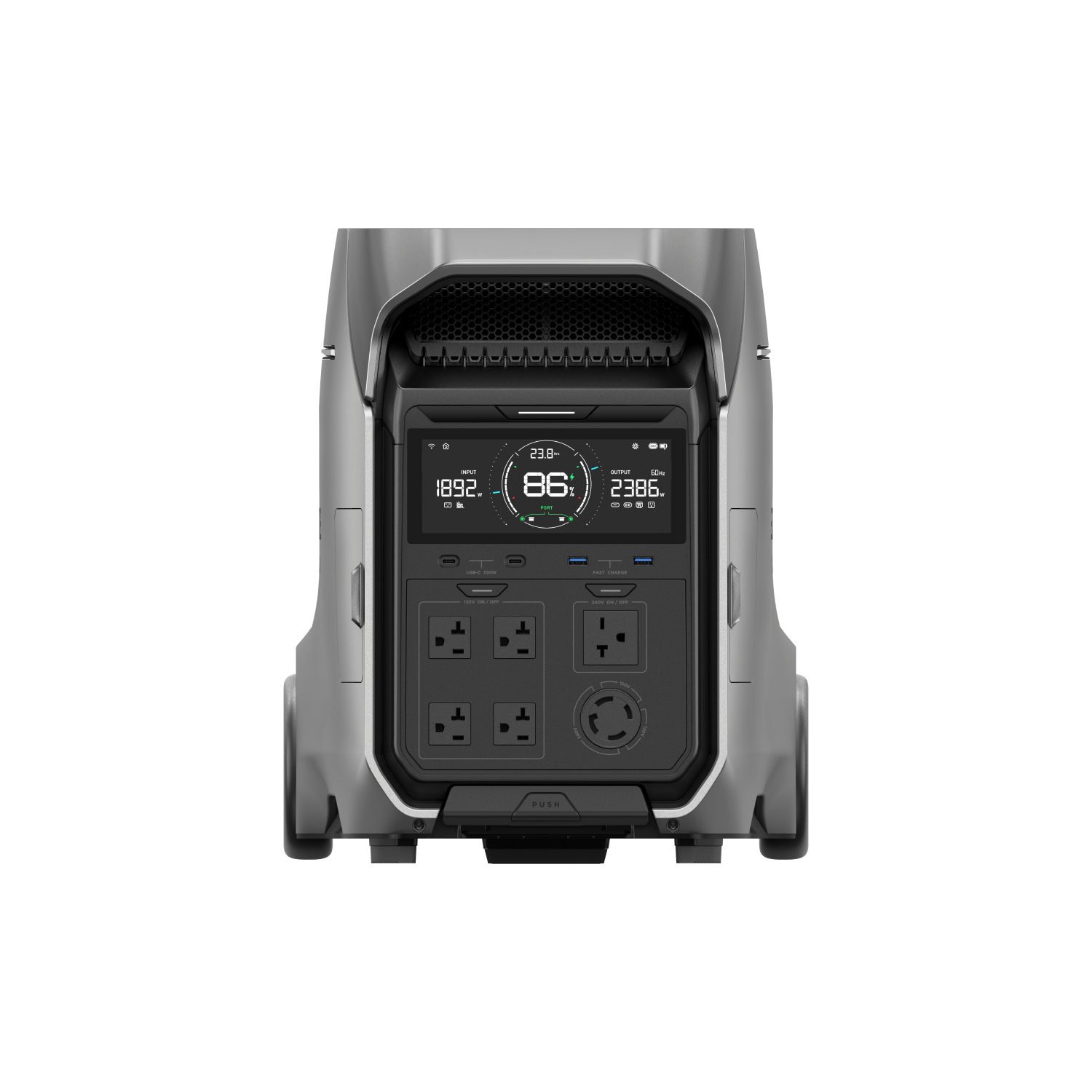
The DELTA Pro 3 is the default recommendation in its class because it pairs the biggest base battery of the big three (4,096Wh rated, about 3,482Wh usable) with a solar input that accepts a full four panel array and 240V whole-home capability. In our checked system configuration it was also the most expensive complete setup, about $4,830.96 with panels and Indiana tax. You pay for capacity and refill speed, and for most homes that is the right place to spend.
Who it fits
Homes whose critical loads average 100 to 200 watts and whose outages run a day or longer. At a 150 watt average load, 3,482 usable watt hours is about 23 hours per charge, and a four panel array in decent sun replaces most or all of a careful day's use, which turns a one day battery into a hold the line system. It feeds a transfer switch, covers the fridge, freezer, furnace blower, and sump rotation that make up real whole-home duty, and expands with extra batteries when a household outgrows the base unit.
Where it loses
- Price. The most expensive of the three as a complete system in our checked configurations, and the gap is hundreds of dollars, not tens.
- Weight and size. Batteries this size are furniture with handles. It will live where it lands, near the panel or the loads, and it is not a take it camping device despite the marketing photos.
- Heavy 240V work. If the load list is dominated by a big well pump and other heavy 240V draws starting together, the Anker's 6,000W native output is the stronger tool. Our head to head shows the trade directly.
Building the system around it
Budget the system, not the box: the station, four rigid 400W panels (see the panel math), the cables, and an electrician if a transfer switch is in the plan. That full configuration is the $4,830.96 figure above, from our checked research with 7 percent Indiana tax. Bought in stages, the sane order is station first, transfer switch second, panels third, expansion battery last, because each stage makes the previous one more useful.
The numbers that decide it
| Figure | DELTA Pro 3 | Why it matters |
|---|---|---|
| Rated capacity | 4,096 Wh | The biggest base battery of the big three |
| Usable capacity at 85% | 3,482 Wh | The number every runtime on this site is planned from |
| Solar input | Accepts a full four panel 400W array | Refill speed matches the battery size |
| Output class | 240V whole-home capable | Feeds a transfer switch and 240V circuits |
| Checked system total | $4,830.96 | Station, four panels, cables, 7 percent Indiana tax |
| Cost per usable Wh | $1.39 | Middle of the three; the full table is here |
One outage, budgeted in watt hours
Runtime claims get honest when the loads are listed. Using this site's planning figures (a fridge averaging 60 watts, a chest freezer 48, a 1/3 HP sump pump 120 in steady rain, lights 36, a router 12), here is what 3,482 usable watt hours buys:
| Load list | Average watts | Runtime on this battery |
|---|---|---|
| Fridge alone | 60 W | about 58 hours |
| Fridge and freezer | 108 W | about 32 hours |
| Plus the sump pump in steady rain | 228 W | about 15 hours |
| Plus lights and router (the full careful list) | 276 W | about 12.5 hours |
The second half of the story is the array. Four 400W panels at Midwest sun hours and real world efficiency harvest roughly 5,400 watt hours across a decent day by the sizing method in our solar sizing guide, which is more than the battery holds. In good sun the system runs the day's loads and refills at the same time. In winter sun or cloud, halve the harvest and the battery drains slowly instead. Either way, this is the only one of the three whose refill speed fully matches its tank. Run your own list in the runtime calculator; the DELTA Pro 3 is its default battery.
Who should skip this
Skip it if your loads are apartment scale (the portable class does the same job lighter and cheaper), or if your budget only stretches to the station alone with no path to panels or a switch. A mid-size station with panels refills. A big station without them just empties more slowly.
Plain links to the manufacturer. We may earn a commission on purchases in the future; today these links are not tracked.
Your next step: see the three big stations head to head.
Read the head to head